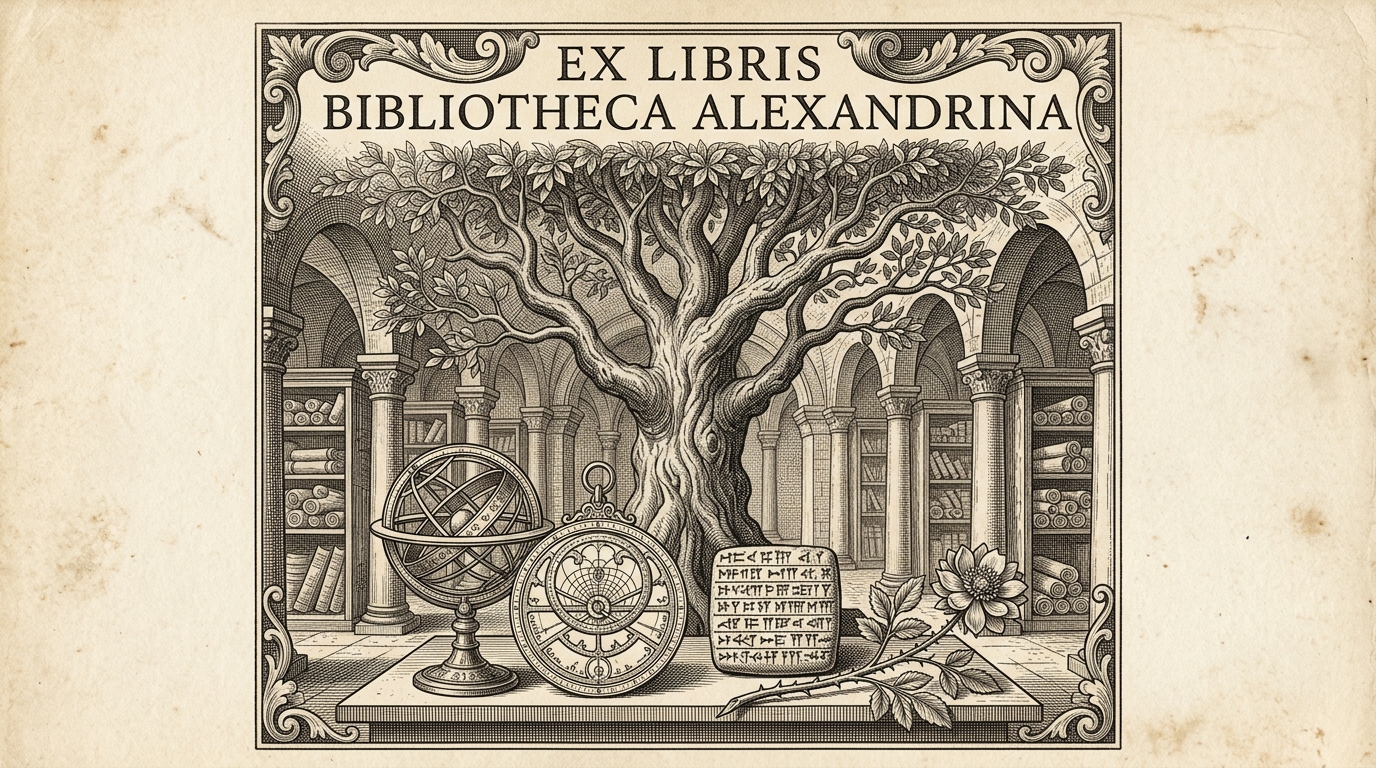
Ex Libris · Bibliotheca Alexandrina
The Search for the Elixir of Youth
From the clay tablets of Sumer and the lost scrolls of Alexandria to autonomous scientific synthesis: humanity’s four-thousand-year quest to gather what is known—and weigh how strongly it is known.
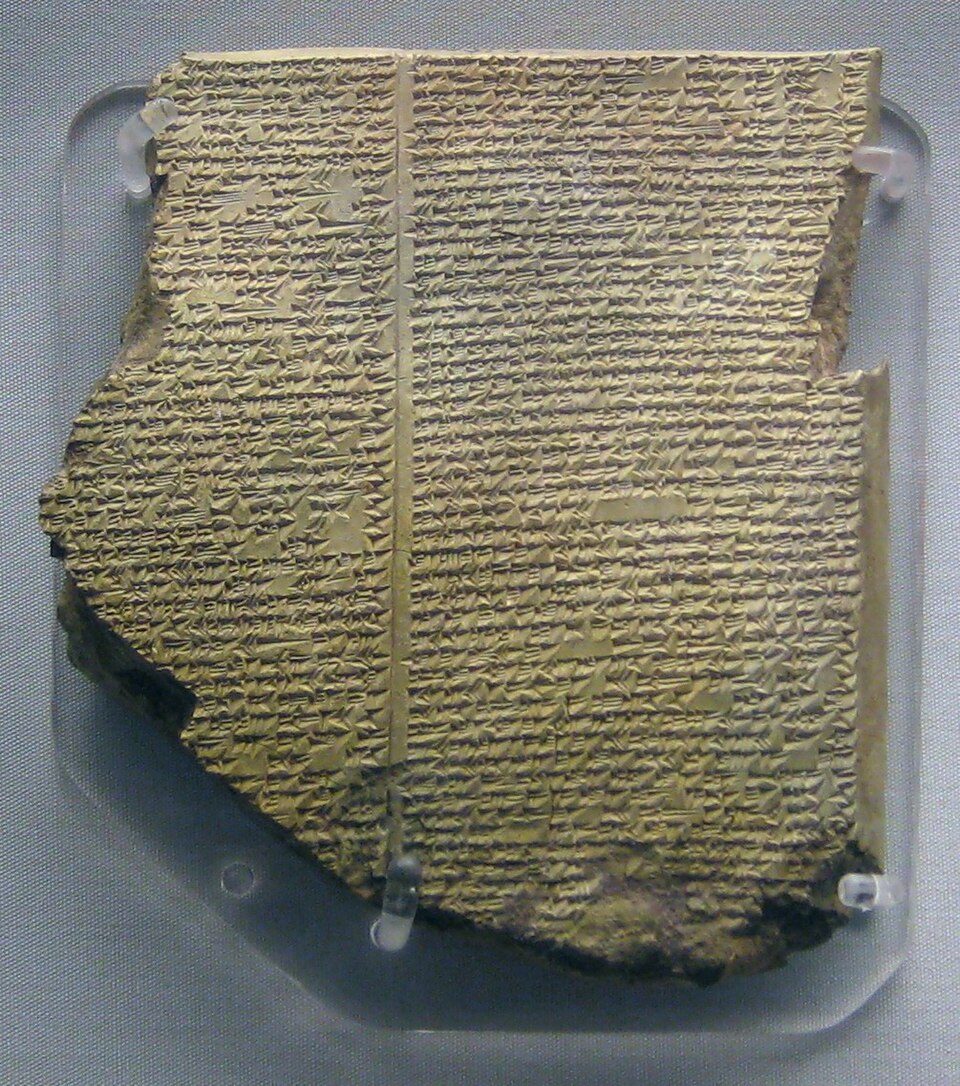
“This plant, Ur-shanabi, is the Plant of Heartbeat: by means of it a man may recapture his vitality. I will carry it back to Uruk-of-the-Sheepfold; I will test it upon an elder, and so prove its virtue.”
I. Sumer, Ur & the First Poem of Humanity
At the dawn of recorded literature—etched in wedge-shaped cuneiform upon clay tablets in the cities of Sumer, Uruk, and the Third Dynasty of Ur (c. 2100 BCE)—humanity wrote down its deepest and most enduring question. Confronted by mortality after the death of his companion Enkidu, the king Gilgamesh (Sumerian Bilgames) crosses the Waters of Death to seek Utnapishtim and learn whether nature holds a remedy against time and biological decline.[1]
Directed to the depths of the freshwater abyss (the Apsu), he ties heavy stones to his feet, descends to the floor of the sea, and plucks a thorny botanical specimen named “The Old Man Becomes Young Again” (Akkadian: Šībū issahir amēlu). Yet notice what the ancient poet records next in Tablet XI: Gilgamesh does not swallow the plant on faith. He announces that he will bring it back to the walled city of Uruk to test it first upon an aged citizen and verify whether its effect is real. Before the trial can be conducted, a serpent sheds its skin at a cool well and steals the plant—leaving humanity with the harder, longer work of patient observation, record-keeping, and cumulative science.[1]
II. Ancient Civilisations, Initiatory Brotherhoods & the Great Library
Across the ancient world, the search for longevity, healing, and natural law moved into temple archives and guarded circles. In Egypt, scribes and physician-priests of the Per Ankh (the “House of Life”) compiled medical papyri such as the Edwin Smith and Ebers scrolls (c. 1600–1550 BCE), pairing empirical anatomical and surgical observations with ritual formularies.[2] In Greece and Magna Graecia, Pythagorean sodalities, Asclepiad guild-physicians at Kos and Knidos, and initiatory schools transmitted mathematical, astronomical, and clinical doctrines under oath.[3] In China and India, Taoist waidan (external alchemy) practitioners and Sanskrit Rasāyana scholars catalogued hundreds of minerals and botanicals in search of the elixir of life—pioneering distillation, metallurgy, and pharmacognosy along the way.[4]
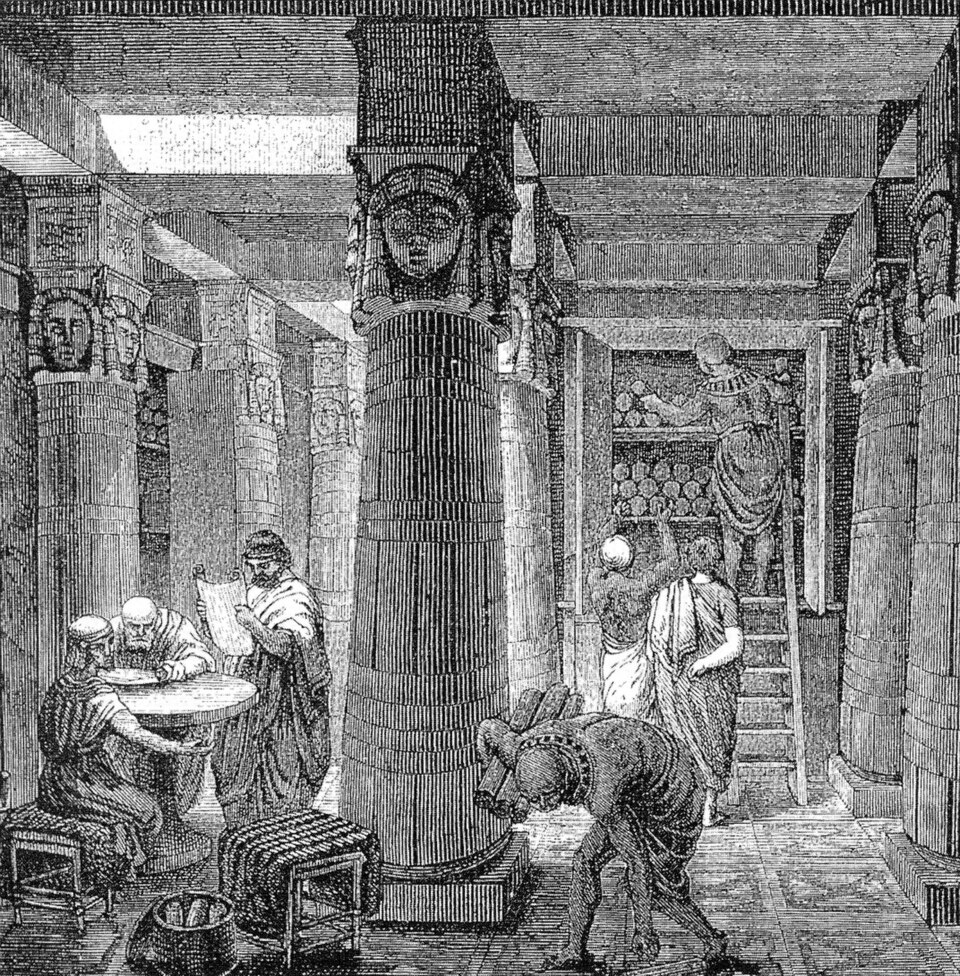
Then, in the third century BCE under the Ptolemaic dynasty, Alexandria attempted something unprecedented in human history: instead of sequestering knowledge inside a closed brotherhood, the Mouseion and the Royal Library of Alexandria sought to gather every scroll in the inhabited world under one roof. Ships docking in the Eunostos harbour had their books requisitioned and copied onto fresh papyrus; the poet-scholar Callimachus of Cyrene compiled the Pinakes (“Tables”)—a 120-scroll critical bio-bibliographical catalogue organising human thought by discipline, author, and provenance.[5]
III. The Roman Empire, the Middle Ages & the Custodians of Parchment
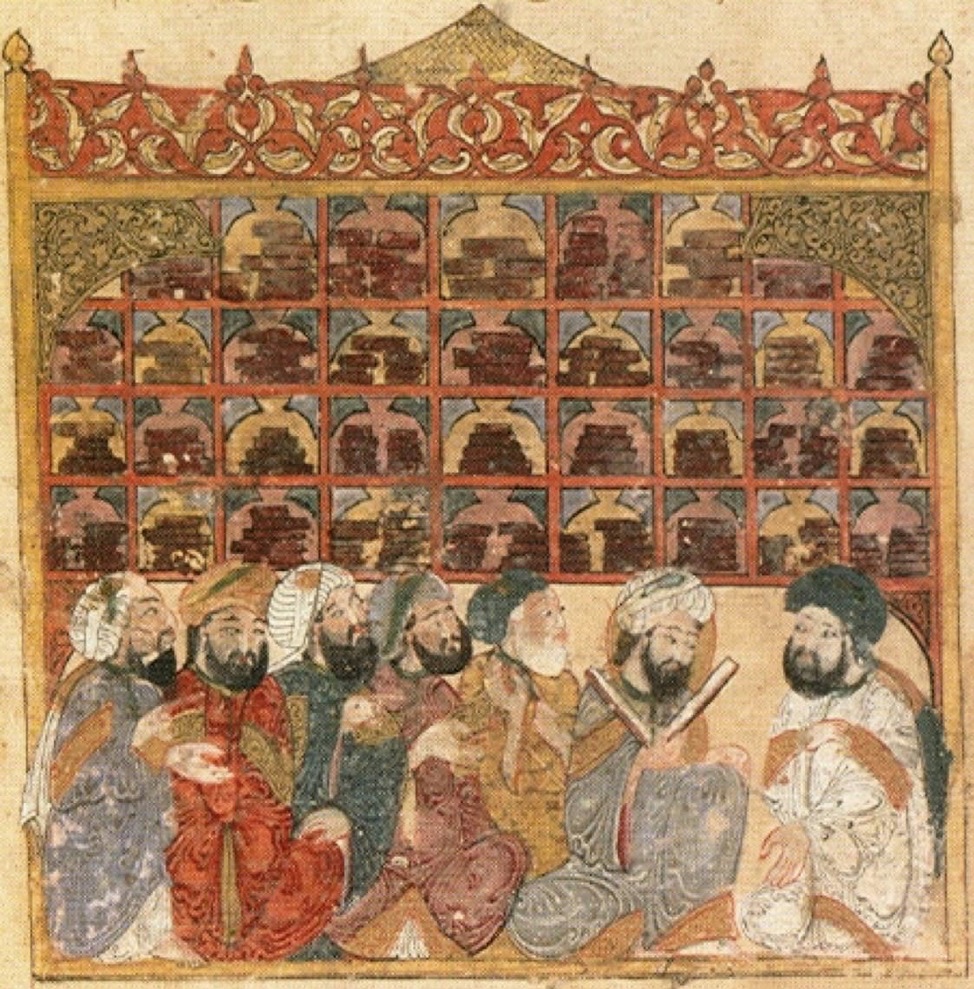
When the great collections of antiquity fractured across centuries of war, fire, and civic decay, the archive of humanity survived only through the devotion of scattered custodians. In the Roman Empire, Pliny the Elder assembled the thirty-seven books of his encyclopaedic Naturalis Historia (77 CE), and Galen of Pergamon synthesised Greek anatomy, pharmacology, and clinical method for a millennium.[6] During the Middle Ages, translators associated with the Abbasid Bayt al-Hikma (House of Wisdom) in Baghdad, physician-philosophers such as Ibn Sina (Avicenna) in his five-book Al-Qānūn fī al-Ṭibb (Canon of Medicine, 1025 CE), monastic scribes illuminating vellum at Vivarium and Monte Cassino, and multilingual translators in Toledo and Salerno preserved Greek, Arabic, Syriac, Latin, and Sanskrit manuscripts line by line.[7]
Simultaneously, Latin and Arabic alchemical traditions—from the Jabirian corpus and al-Rāzī to Roger Bacon, John of Rupescissa’s quinta essentia, and Paracelsus’s iatrochemistry—kept alive the ancient dream of the Elixir Vitae: a purified medicine capable of arresting corruption and prolonging human vigour.[8] Yet so long as books had to be copied by hand and locked in private chests or abbey towers, two fatal flaws remained: a single fire could erase a century of thought, and an untested assertion written in fine ink looked identical to a verified truth.
IV. The Enlightenment & the Scientific Revolution
Moveable type broke the monopoly of the locked scriptorium; anyone who walked into a public reading room could smell the rag-linen paper, oak-gall ink, and calfskin bindings of a shared human inheritance. With the Scientific Revolution and the Enlightenment—from Francis Bacon’s Novum Organum (1620) and the Royal Society’s 1660 motto Nullius in verba (“take nobody’s word for it”)[9] to Diderot and d’Alembert’s Encyclopédie (1751–1772), which explicitly mapped all human knowledge as an Arbre Encyclopédique (Tree of Knowledge)[10]—humanity discovered the true elixir: empirical method.
Alchemy matured into quantitative chemistry; astrology gave way to celestial mechanics; and traditional physic was subjected to controlled clinical comparison, exemplified by James Lind’s May 1747 prospective citrus trial aboard HMS Salisbury.[11] Over the next two centuries, culminating in the modern Evidence-Based Medicine hierarchy, humanity established a formal principle: not all claims carry equal epistemic weight. An anecdote or case report is not a cohort study, a cohort study is not a randomised controlled trial, and a single trial is not a systematic meta-analysis.[12]
V. The Information & Autonomous Intelligence Revolution
Today we face the inverse crisis of antiquity. The scrolls were not burned; they multiplied beyond individual human comprehension. Every year, millions of peer-reviewed articles, preprints, clinical trial registrations, and regulatory assessments are added to the biomedical and scientific record. No physician, researcher, or citizen can read ten thousand primary papers before making a life-altering decision—and in the gap between primary literature and the public, commercial hype and unverified lore flourish just as they did in the marketplaces of the ancient world.
Yet we now stand in the Information Revolution, at the threshold of autonomous computational synthesis. For the first time in history, machines can accept a question in plain English, dispatch tireless workers across the world’s open scientific repositories (Europe PMC, OpenAlex, ClinicalTrials.gov, and the open web), read the primary literature, extract concrete claims with verbatim provenance, and—crucially—grade every finding in deterministic code by the rigour of the study design behind it (T1 systematic reviews and randomised trials down to T6 unverified commentary).[12]
So the dream that began four thousand years ago in Uruk and took shape in the halls of Alexandria is finally possible: to hold all of humanity’s scientific archive at our fingertips, organised as a living Tree of Knowledge—where frontier and minority ideas are preserved and labelled rather than censored, where marketing is separated from evidence, and where every branch belongs not to one person, but to all of humanity.
We ask, and it shall be provided from Humanity’s archive of knowledge.
Scholarly References & Primary Sources
- George, A. R. (2003). The Babylonian Gilgamesh Epic: Introduction, Critical Edition and Cuneiform Texts (Vols. 1–2; Tablet XI, lines 278–307, pp. 720–725, recording the thorny plant Šībū issahir amēlu and Gilgamesh’s proposed trial in Uruk). Oxford University Press. ISBN 978-0-19-814922-4. Primary cuneiform witness: British Museum K.3375 (Royal Library of Ashurbanipal, Nineveh, 7th century BCE). ↩
- Gardiner, A. H. (1938). “The House of Life.” The Journal of Egyptian Archaeology, 24(2), 157–179 (doi:10.1177/030751333802400131); see also Allen, J. P. (2005). The Art of Medicine in Ancient Egypt (including the Edwin Smith Surgical Papyrus). New York: The Metropolitan Museum of Art / Yale University Press. ↩
- Jouanna, J. (1999). Hippocrates (M. B. DeBevoise, Trans.). Baltimore: Johns Hopkins University Press; and Zhmud, L. (2012). Pythagoras and the Early Pythagoreans. Oxford University Press (doi:10.1093/acprof:oso/9780199289318.001.0001). ↩
- Needham, J. (1974). Science and Civilisation in China, Vol. 5: Chemistry and Chemical Technology, Part 2: Spagyrical Discovery and Invention: Magisteries of Gold and Immortality. Cambridge University Press; and Wujastyk, D. (2003). The Roots of Ayurveda: Selections from Sanskrit Medical Writings (Caraka and Suśruta Saṃhitās on Rasāyana rejuvenation). Penguin Classics. ↩
- MacLeod, R. (Ed.). (2000). The Library of Alexandria: Centre of Learning in the Ancient World. London: I.B. Tauris; and Blum, R. (1991). Kallimachos: The Alexandrian Library and the Origins of Bibliography (H. H. Wellisch, Trans.). University of Wisconsin Press. ↩
- Pliny the Elder (c. 77–79 CE). Naturalis Historia (H. Rackham, W. H. S. Jones, & D. E. Eichholz, Trans., 10 vols., Loeb Classical Library, Harvard University Press, 1938–1963); and Nutton, V. (2012). Ancient Medicine (2nd ed.). Routledge (doi:10.4324/9780203081297). ↩
- Gutas, D. (1998). Greek Thought, Arabic Culture: The Graeco-Arabic Translation Movement in Baghdad and Early ‘Abbasid Society (2nd–4th/8th–10th Centuries). Routledge (doi:10.4324/9780203316276); Ibn Sīnā (Avicenna) (1025). Al-Qānūn fī al-Ṭibb (The Canon of Medicine); and Reynolds, L. D., & Wilson, N. G. (2013). Scribes and Scholars: A Guide to the Transmission of Greek and Latin Literature (4th ed.). Oxford University Press. Primary manuscript witness for Fig. 4: al-Ḥarīrī, Maqāmāt, illustrated by Yaḥyā ibn Maḥmūd al-Wāsiṭī (1237 CE), BnF MS Arabe 5847, fol. 5v. ↩
- Principe, L. M. (2013). The Secrets of Alchemy. University of Chicago Press; and DeVun, L. (2009). Prophecy, Alchemy, and the End of Time: John of Rupescissa in the Late Middle Ages. Columbia University Press. ↩
- Eisenstein, E. L. (1979). The Printing Press as an Agent of Change: Communications and Cultural Transformations in Early-Modern Europe. Cambridge University Press; Bacon, F. (1620). Novum Organum Scientiarum (London: John Bill); and Sprat, T. (1667). The History of the Royal-Society of London, for the Improving of Natural Knowledge. ↩
- Diderot, D., & d’Alembert, J. le Rond (Eds.). (1751–1772). Encyclopédie, ou dictionnaire raisonné des sciences, des arts et des métiers (Vol. 1, Discours préliminaire & Système figuré des connaissances humaines). Paris: Briasson, David, Le Breton, & Durand. ↩
- Lind, J. (1753). A Treatise of the Scurvy. In Three Parts. Containing an Inquiry into the Nature, Causes, and Cure, of that Disease (Part II, Chap. IV, pp. 149–153, documenting the May 1747 controlled clinical trial aboard HMS Salisbury). Edinburgh: Sands, Murray, and Cochran; see also Tröhler, U. (2003). “James Lind and the evaluation of clinical treatments.” James Lind Library. ↩
- Evidence-Based Medicine Working Group (Guyatt, G., Cairns, J., Churchill, D., et al.) (1992). “Evidence-based medicine. A new approach to teaching the practice of medicine.” JAMA, 268(17), 2420–2425 (doi:10.1001/jama.1992.03490170092032); and OCEBM Levels of Evidence Working Group (Howick, J., et al.) (2011). The Oxford 2011 Levels of Evidence. Oxford Centre for Evidence-Based Medicine. ↩